Showing posts with label Archaeology. Show all posts

Thursday, July 23, 2015

Bloody Beakerfolk, coming over here.....

... bringing their drinking vessels and making us drink from cups.....


(at 3 min 40 sec)


(and the bloody Anglo Saxons.... and the bloody neolithic people.....)

Sunday, June 7, 2015

Archaeology: Will the study of archaeology soon become a thing of the past?

Will the study of archaeology soon become a thing of the past?
Richard III's discovery showcased UK academia, says Michael Braddick. But as student demand for certain subjects falls, should we have grave concerns for our future knowledge base?

Greyfriars car park, Leicester, where the remains of King Richard III were found
Greyfriars car park, Leicester, where the remains of King Richard III were found. 
Photograph: Darren Staples/Reuters
Tuesday 19 February 2013 16.11 GMT Last modified on Wednesday 21 May 2014 16.31 BST

Finding Richard III (on the premises of Leicester social services no less) is testament to the ingenuity of archaeologists. Weaving together findings from historical analysis of texts with scientific analysis of the skeleton and the site, they have made an overwhelming case that these are the remains of the king.

As a historian, I spend a lot of time trying to listen to the dead. Every now and then a curtain seems to be pulled aside and we hear them directly, and the feeling is very powerful. The way that the wounds to the skull match with one of the historical accounts of Richard's death did that for me: I was taken to Richard's final moments, as his helmet was lost and his attackers closed in, his horse gone or stuck in the mud, the moments in other words when he knew he had lost his kingdom and his life. That human connection is precious, and rare.

This ingenious work has recovered an important part of our heritage and will no doubt have direct economic benefits. "The King under the Car Park", as Channel 4 had it, will no doubt stimulate our creative and heritage industries. Leicester University's archaeology department will, I hope, thrive on the publicity.

The findings go some way to resolving the question of how the story of Richard's crooked back was exaggerated for political purposes. For me, though, the real academic significance of the find is its demonstration of the power of archaeological techniques.

Combining insights from natural and social sciences, archaeology offers an exceptionally powerful way of understanding many of the most inscrutable aspects of our past – think of the difficulty of interpreting Stonehenge, for example, and what has now been achieved by this kind of sophisticated analysis. Archaeologists have plenty to tell us about the impact of climate change and fuel use, or the rise and decline of complex societies: they give us access, in other words, to a vast store of human experience, which is of direct relevance to some of the greatest challenges we now face.

Despite the value and interest of what they do, archaeology departments up and down the country are now facing difficulty. The reason? Undergraduate demand has fallen, and there is no other way for them to pay their bills.

This situation reflects a key principle of the Browne review: that investment in higher education should be driven by student demand, informed by information about the price and quality of courses. Archaeological science is expensive, and does not attract research funding driven by the search for economic growth. Student numbers are low, nationally, and although student satisfaction measures and price put it on a par with history and English, archaeology departments cannot attract students in the same numbers, and are finding it hard to cover their costs.

A second aspect of government policy exacerbates the problem, the "core and margin" policy. Universities can now recruit unlimited numbers of students with A-level grades of ABB or better (the 'margin' which can grow), but are allocated reduced numbers of places for students with lower grades (the 'core' allocation). Archaeology has traditionally recruited heavily among 'core' students (often those from poorer backgrounds), and departments around the country are being caught by this. Highly selective universities now have a relatively small 'core', and little room for manoeuvre in mitigating short-term movements in demand among high performing A-level students.

The intention is to allow such universities to grow, but it also creates an incentive for them to disinvest from disciplines with weak demand among applicants with high A-level grades. There is no corresponding incentive for other universities to take up that provision. A likely outcome of this is that there will be reduction in national capacity in archaeology, and particularly in expensive archaeological science. We will all be the poorer for that.

Archaeology is not alone. 'Hard' or 'small' languages are also under pressure. They too, will struggle to make their way on the basis of research grants so that the national capacity in Russian, German and Portuguese are likely to decline. As with archaeology, a standard university response will probably be to reduce costs – by concentrating on language teaching, and reducing the provision in the politics, sociology, history or literature of those societies. We might expect more degrees in, say, politics with Russian language, emphasising accurate use of the language, and many fewer which emphasise cultural understanding in the fullest sense.

While this may satisfy student demand, and allow universities to continue to prosper, it would represent a significant loss to our national research capacity and knowledge base.

The debate about the Browne review, and its implementation has so far concentrated on the effects of high fees on the aspirations of our young people, and on the prospects of our universities as individual institutions. It's time, I think, to discuss a third dimension – the future of particular disciplines, and the risk that students and universities, acting rationally in the context in which they have been placed, fail between them to generate the necessary investment to sustain these areas.

Small policy adjustments could help. Universities are currently allocated places in strategically important and vulnerable subjects (SIVS) irrespective of A-level performance. This is helping with languages, but archaeology and other subjects are not protected, while all suffer from the effects of the core and margin policy in selective universities.

It is a classic collective action problem – no university or individual student has a particular interest in shouldering the costs of the necessary investment, and so we run the risk that no one will make it. Letting that rip is no less a decision than implementing a political solution to it, and it would be cheap to solve.

Let's at least make a conscious decision, following a proper discussion, that this is the way to plan the national knowledge base.

Michael Braddick is professor and pro-vice-chancellor for the faculty of arts and humanities at the University of Sheffield


This content is brought to you by Guardian Professional. To get more articles like this direct to your inbox, become a member of the Higher Education Network.

Archaeology: Dazzling jewels from an Ethiopian grave reveal 2,000-year-old link to Rome

British archaeology team uncovers stunning Aksumite and Roman artefacts
Grave in Ethiopia

The grave in Ethiopia where the woman dubbed ‘Sleeping Beauty’ was discovered. 
Photograph: Graeme Laidlaw
Spectacular 2,000-year-old treasures from the Roman empire and the Aksumite kingdom, which ruled parts of north-east Africa for several centuries before 940AD, have been discovered by British archaeologists in northern Ethiopia.

Louise Schofield, a former British Museum curator, headed a major six-week excavation of the ancient city of Aksum where her team of 11 uncovered graves with “extraordinary” artefacts dating from the first and second centuries. They offer evidence that the Romans were trading there hundreds of years earlier than previously thought.

Schofield told the Observer: “Every day we had shed-loads of treasure coming out of all the graves. I was blown away: I’d been confident we’d find something, but not on this scale.”

She was particularly excited about the grave of a woman she has named “Sleeping Beauty”. The way the body and its grave goods had been positioned suggest that she had been beautiful and much-loved.

Schofield said: “She was curled up on her side, with her chin resting on her hand, wearing a beautiful bronze ring. She was buried gazing into an extraordinary Roman bronze mirror. She had next to her a beautiful and incredibly ornate bronze cosmetics spoon with a lump of kohl eyeliner.”

Perfume flask found at the site.

The woman was also wearing a necklace of thousands of tiny beads, and a beaded belt. The quality of the jewellery suggests that she was a person of very high status, able to command the very best luxurious goods. Other artefacts with her include Roman glass vessels – two perfectly preserved drinking beakers and a flask to catch the tears of the dead.

There was also a clay jug. Schofield hopes that its contents can be analysed. She believes it would have contained food and drink for the afterlife.

Although “Sleeping Beauty” was covered only with soil, her grave was cut into a rock overhang, which is why the finds survived intact.

The team also found buried warriors, with each skeleton wearing large iron bangles. They may have been killed in nearby battlefields.

Other finds include another female skeleton with a valuable necklace of 1,065 coloured glass beads, and, elsewhere, a striking glass perfume flask.

In 2012, the Observer reported that Schofield’s earlier excavations in the region had discovered an ancient goldmine that may solve the mystery of from where the Queen of Sheba of biblical legend derived her fabled treasures.

Aksum, the capital of the Aksumite kingdom, was a major trading power from the first to the seventh centuries, linking the Roman Empire and India. Aksumites were a literate people. Yet little is known about this so-called “lost”’ civilisation.

“Ethiopia is a mysterious place steeped in legend, but nobody knows very much about it,” said Schofield. “We know from the later Aksumite period – the fourth and fifth centuries, when they adopted Christianity – that they were trading very intensely with Rome. But our finds are from much earlier. So it shows that extraordinarily precious things were travelling from the Roman Empire through this region centuries before.”

In return, the Romans sought ivory tusks, frankincense and metals. Schofield’s excavations also found evidence of iron working.

The finds will go to a new German-funded museum, opening in October. Schofield hopes to organise a loan to the British Museum, but first the finds must be conserved: the mirror, for example, is corroded and slightly buckled. Germany is sending nine conservators.


Excavations were paid for by the Sainsbury family’s Headley Trust and the Tigray Trust, a charity that promotes sustainability in the region; and by individual donations.


Saturday, November 12, 2011

Standing with Stones

A Journey through megalithic Britain and Ireland. Done by Non-archaeologists. A great programme! Beautiful photography and very interesting views and good questions. And because it was done by non-archaeologists, they get away with stuff, you d be hanged as archaeologist.... :o)

And I like the soundtrack, all spacy and mystical.... 2 hours I didnt regret last night, the same way I didnt regret the red wine that went with it....


Just click on the following 13 parts once the first part is finished.


Want to know more? Here the film-makers website: http://standingwithstones.net/

Sunday, November 6, 2011

The secret of successfull writing

An archaeologist who I know once said, when asked what the secret of successful writing is: Place your behind in a seat and keep it there.

I keep wondering, if he left out an important piece of information: the magic chair!

Now, that would be an artefact to have. Forget the arc of convenant, the holy grail or the magic cartpet. find me the magic writing chair.....

Steppenwolf - Magic Carpet Ride


In another but similar (and by far not as nice) way Manfred Baron von Richthofen put it:
Success flourishes only in perseverance - ceaseless, restless perseverance.

Friday, October 21, 2011

Gold hoard thrown in skip displayed

Early Bronze Age gold recovered from a skip in Co Roscommon in 2009 has gone on display


Thursday October 20 2011
A hoard of Early Bronze Age gold that was salvaged from a skip following a botched robbery has gone on display.
The ancient artefacts were recovered by gardai in 2009 after being dumped along with the stolen safe they had been kept in at Sheehan's Pharmacy in Strokestown, Co Roscommon.
The thieves had not realised that the 5,000-year-old gold was hidden among documents when they tipped out what they thought were the safe's worthless contents.
Tony Candon, manager at the National Museum of Ireland where the gold will go on display, said: "Those thieves missed out big time when they unknowingly threw this treasure away."
The Sheehan family acquired the artefacts - a gold crescent shaped collar known as a lunula and two gold discs - in 1947, two years after Hubert Lannon dug them up in a Coggalbeg bog near Strokestown. They kept them in the pharmacy's safe ever since, only occasionally taking them out through the years.
Mr Candon explained: "Mr Lannon found the gold when he was cutting up turf in 1945. Two years later he gave it to Patrick Sheehan and he kept it in the safe.
"The family knew over the years that they had something valuable and important. They treated it as a family heirloom and it had been at the back of their minds. But then when the safe was stolen, it occurred to them the gold was inside. That's when they got in touch with the museum about it."
It is believed the thieves failed to notice the artefacts when they threw the safe's contents in a skip. The gold weighs 78 grams or 2.5 ounces.
Minister for arts Jimmy Deenihan opened the exhibition at the Museum of Country Life in Turlough Park, Castlebar. He said: "An extraordinary series of unlikely events led to the discovery of the most significant hoard of Early Bronze Age goldwork from Ireland for many years. From an archaeological perspective this hoard is of great significance."
The exhibition will run until next summer before the gold is moved to the main National Museum of Ireland on Kildare Street in Dublin.
Press Association


Monday, August 1, 2011

The Road less travelled...

...nonetheless my road. The road of an archaeologist. with lots of schtones....

 Watch where you can. Enthralling! Let me know if the playlist works or of you have to continuously click for the next parts. And my personal thanks to zodiacs who went through all the series and uploaded them onto YouTube. How did we just live before the Internet????

The Edwardian Farm (Series on BBC)

The Victorian Farm

The Victorian Farm Christmas

The Victorian Pharmarcy


Thursday, July 28, 2011

Sunday, July 17, 2011

Göbekli Tepe

Just stumbled upon this, have to read up more, so this is more like a note to myself

Göbekli Tepe [ɡøbe̞kli ťe̞pɛ] (Kurdish: Girê Navokê) is a hilltop sanctuary erected on the highest point of an elongated mountain ridge some 15 kilometres (9.3 mi) northeast of the town of Şanlıurfa (formerly Urfa /Edessa) in southeastern Turkey. The site, currently undergoing excavation by German and Turkish archaeologists, was erected by hunter-gatherers in the 9th millennium BC (c. 11,000 years ago). 

Or the quick look on youtube:


Sources:


Friday, July 15, 2011

Curse of the Iceman

http://en.wikipedia.org/wiki/Image:Otzi.jpg

In 1991, a pair of German tourists discovered the frozen corpse of a Copper Age man in the Alps, where it had apparently lain undisturbed since 3,300 B.C. “Ötzi” had died in a fight, it seems: A CAT scan found an arrowhead in one shoulder, and he had bruises and cuts on his hands, wrists, and chest. DNA analysis also found blood from four other people on his gear.
If he was ornery in life, apparently his ghost was worse. In all, eight people connected with the iceman have died unexpectedly. In 1992, the head of the investigating forensic team died in a head-on collision. The mountaineer who led scientists to the body died in an avalanche. An Austrian journalist who covered the body’s removal died of a brain tumor, and the tourist who found it fell into a ravine on the mountain.
Have investigators unleashed a mysterious curse, like that of King Tutankhamen? “I think it’s a load of rubbish,” said the leading expert on the corpse, archaeologist Konrad Spindler. “It is all a media hype. The next thing you will be saying I will be next.”
He died in April 2005.

Source: http://www.futilitycloset.com/2006/08/29/curse-of-the-iceman/

Monday, June 27, 2011

Jared Diamond on past civilizations

"The monumental ruins left behind by past societies hold a romantic fascination for all of us ... We feel drawn to their often spectacular and haunting beauty, and also to the mysteries that they pose."

Jared Diamond, Multi-field scientist and author of 'Guns, Germs and Steel' and other books, professor of geography and physiology

Wednesday, June 15, 2011

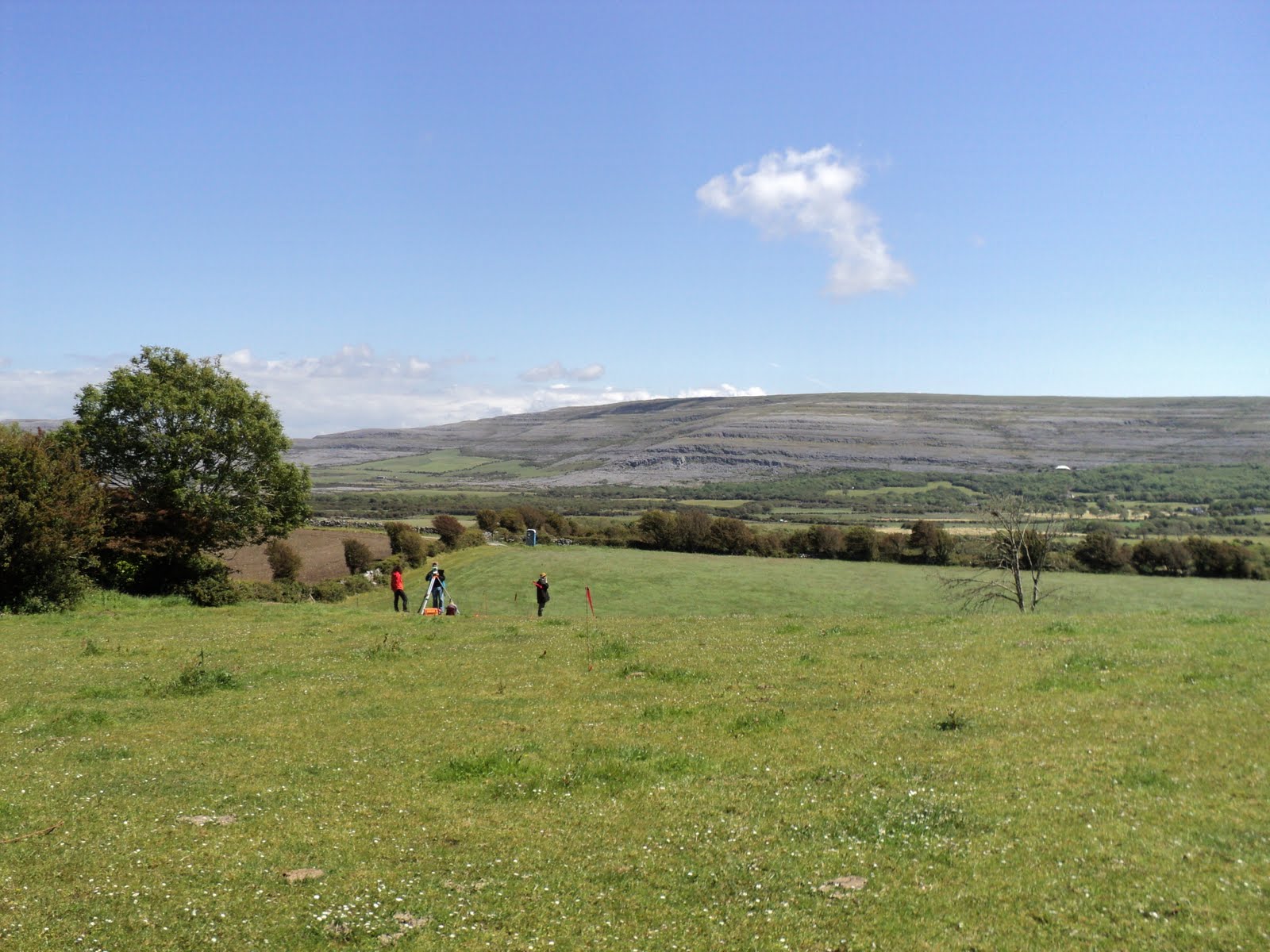
First Pictures of Archaeological Survey

of the Deserted village of Lios an Riu, near Ballyvaughan, Co. Clare

it is just glorious to stand in this field with the weather like that and having the privilege to see the whole valley like that! I would not want to be anywhere else. And for the last three days we have been taking earthresisitivity measurement and will do magnetotometry readings from tomorrow onwards.


the structures are in the little wood behind the field and all the stones are overgrown with moss.


can anybody see the wall or any other feature, resembling any sort of structure? in the meantime i will call this: "the Rockery"....;o)

Tuesday, May 17, 2011

Donal Cam O'Sullivan Beare


Donal Cam O'Sullivan Beare, Prince of Beare, 1st Count of Berehaven (Irish: Domhnall Cam Ó Súilleabháin Bhéara) (1561–1618) was the last independent ruler of the O'Sullivan Beara sept, and thus the last O'Sullivan Beare, a Gaelic princely title, in the southwest of Ireland during the early seventeenth century, when the English were attempting to secure their rule over the whole island.

Early life

Donal's father was killed in 1563, but his son was considered to be too young to inherit and the clan leadership passed to the chief's surviving brother Owen, who was confirmed by English authorities in Dublin with the title Lord of Beare and Bantry. In order to consolidate his position, Owen accepted the authority of Queen Elizabeth I of England and was knighted. In 1587 Donal asserted his own claim to leadership of the clan, petitioning Dublin to put aside Owen's appointment with a claim derived from English laws based on absolute male primogeniture. These laws did not recognise age as relevant to inheritance rights. Keen to extend English legal authority over Ireland, the Dublin commission accepted Donal's claim. He now became "the O'Sullivan Beare". 

Nine Years War
By 1600 Munster had been devastated by battle, and the Gaelic clans lost over half a million acres (4,000 km²) of land to settlers from England following the defeat of the Desmond Rebellions.

In the lead up to the Nine Years' War O'Sullivan kept his distance from the rebel cause, but in time he joined a confederation of Gaelic chiefs led by Hugh O'Neill, Earl of Tyrone and Hugh Roe O'Donnell of Ulster. Conflict had broken out in 1594, and O'Neill secured support from Philip II of Spain. The Spanish sent a force under the command of Don Juan D'Aquilla in 1601. O'Sullivan wrote to the Spanish king in submission to his authority, but the letter was intercepted by the English. In early 1602 the allied Irish and Spanish forces met the English at the Battle of Kinsale and were defeated.

O'Sullivan resolved to continue the struggle by taking control of the Castle of Dunboy. In 1603 English forces attacked Dunboy and the castle fell after a vicious siege. The entire company of defenders was killed in combat or executed. 

O'Sullivans march
Donal himself was absent from the siege, having travelled to the north of the island for a conference with Hugh O'Neill. His letter to Philip left him with little hope of a pardon from the English, and he continued the fight with guerilla tactics.

He was eventually forced to gather up his remaining followers, including women and children, and set off on a long march for the north. He fought a long rearguard action across Ireland, during which the much larger English force fought him all the way, as did rival Irish leaders. The march is one of the most poignant in Irish history and was marked by enormous suffering as the fleeing and starving O'Sullivans sought food from an already decimated Irish countryside in winter, often resulting in hostility, such as from the Mac Egans at Redwood Castle in Tipperary. O'Sullivan marched through Aughrim, where he raided villages for food and met with local resistance. He was barred entrance to Glinsk castle and led his refugees further north. On their arrival at the refuge of O'Rourke's castle in Leitrim, only 35 of the original 1,000 remained, many having died in battles or from exposure and hunger. Others had settled along the route, where their descendants are known to this date as 'the Beres'.

In Leitrim, O'Sullivan sought to join with other northern chiefs to fight the English and organised a force to this end, but resistance ended when Hugh O'Neill, 2nd Earl of Tyrone  signed the Treaty of Mellifont. O'Sullivan, like other member of the Gaelic nobility of Ireland who fled, sought exile, making his escape to Spain by ship.

Exile
When he left Ireland, Cornelius O'Driscoll and other Irish knights helped him and his clan. In Spain O'Sullivan was welcomed by King Philip III. His princely status was reconfirmed, and he received a commission as an imperial general. His cousin, Pilib ó Súilleabháin Bhéara, was particularly important in this regard and his 1618 disquisition in Latin, A Briefe Relation of Ireland and the diversity of Irish in the same was particularly influential.

In 1618, O'Sullivan was murdered just as he was departing a mass. He was murdered in Plaza Santo Domingo (Madrid). The murderer was John Bathe, a young Englishman who had been disfigured in a duel by the prince's nephew, on account of some arguments between Bathe and O'Sullivan. Today it's known the man was a spy on behalf the English Crown.

O'Sullivan enjoyed a wide reputation, which helped to open doors for later soldiers from his line. About 165 years later, one descendant, John Sullivan, served as a general in the American Revolution. 

here the article on Wikipedia: Donal O'Sullivan

a brilliant theatre play written and performed by Aidan Dooley: http://www.aidandooley.co.uk/archives/category/o-sullivan-beara-the-last-gaelic-chieftain


Wednesday, April 27, 2011

Treasure from the Bog

Watch while (and where) you can!!!


Treasure from the Bog


A psalter from the 9th century found in a Tipperary bog hinting towards a link of early irish christian monks to the coptic community in the north of egypt.


Sunday, April 24, 2011

Sodom und Gomorrha

aus eher archaeologischer Sicht....
(und mein Herz schlaegt hoeher.... :)


Eine der Hauptthesen der Dokumentation: Das Bronzezeitalter hat nicht nur den Gebrauch von Metallen hervorgebracht, sondern auch die Stadt als solches hervorgebracht. Ein wenig allgemein gehalten, aber macht kausalattribuitiv sinn. Aber: Erstens hat es mit Kupfer angefangen und erst spaeter entwickelte sich die Bronze als 2. Schritt (1. Schritt: gewinnung und verarbeitung von Kupfer und dann LEGIERUNGEN sprich metalle zu mischen. Im Falle von Bronze: Kupfer und Zinn). Wie dem auch sei, die Doku unterstuetzt meine These, dass die Menschheit spaetestens ab dem Aufbrechen der Erde, um Metall zu gewinnen, sich im Niedergang befindet......


Thursday, April 21, 2011

Friday, April 15, 2011

Of course is Archaeology treasure hunting...

... to a certain degree.

Spuren einer Schlacht: Der schwedische Archäologe Bo Knarrström zeigt eine Gewehrkugel, die bei Lützen auf dem Gelände der Hauptschlacht des Dreißigjährigen Krieges (1618-1648) gefunden wurde.


Außergewöhnlicher Fund: Der bei Lützen entdeckte bronzene Löwenkopf symbolisiert König Gustav II. Adolf (1594 bis 1632) als Verteidiger des Protestantismus. Seine katholischen Feinde sind als Schlange dargestellt, die sich im Maul des Löwen windet.


Suche nach Relikten: Die Forscher haben bisher mehr als 10.000 Gegenstände entdeckt, die mit der Schlacht bei Lützen im Zusammenhang stehen.


Kleinarbeit: Der britische Archäologe Timothy Sutherland untersucht eine Bodenprobe.

Bronzene figürliche Hakenverschlüsse: Sie sind Zeugnisse der sogenannten Nürnberger Rotschmiedearbeit. Wenige Monate vor der Schlacht bei Lützen hatten sich Wallenstein und Gustav II. Adolf vor Nürnberg bereits gegenübergestanden.

Archäologe mit Metalldetektor und Spaten: Eine Untersuchung des gesamten Schlachtfeldes wird nicht möglich sein - die Forscher hiffen, die Hälfte oder zwei Drittel zu schaffen. Die restliche Fläche ist bebaut oder von Wäldern bedeckt.


 Hier geht es zur Spiegel.de Fotostrecke: Archaeologen untersuchen Schlachtfeld vom 30jaehrigen Krieg (1618-1648) bei Luetzen